
Today on Catbells
Loading today's summit forecast and sunrise…
Forecast for the summit area from the Met Office, adjusted for height. Summit winds are often stronger than forecast: also check MWIS.
Where the Sun Comes Up
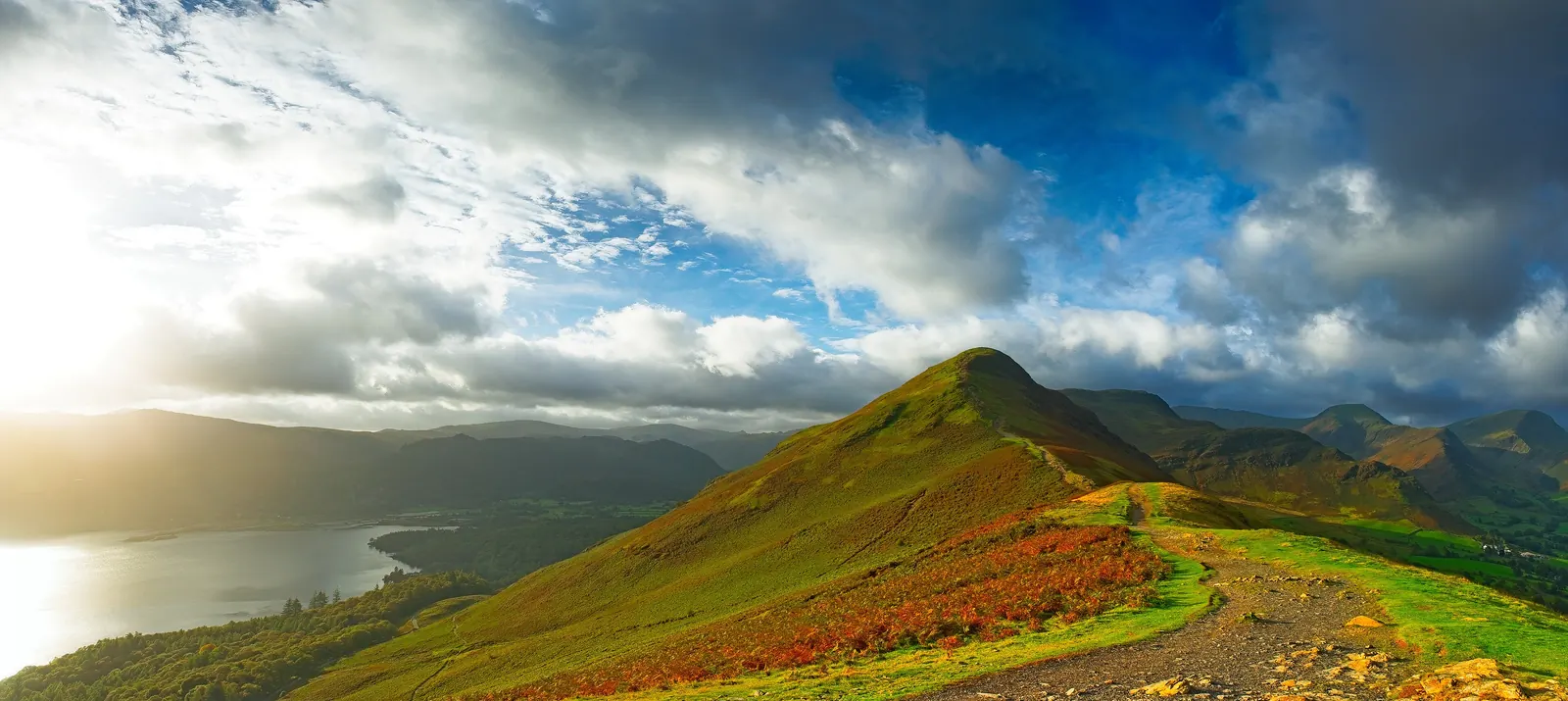
From the summit you look east across the lake to Walla Crag and the long moorland ridge above it, with Skiddaw to the north behind Keswick and Blencathra to the north-east. In midsummer the sun rises well round to the north-east, over towards Blencathra; in midwinter it comes up in the south-east, over the high ground between Derwentwater and Thirlmere. On a still morning there is often mist lying on the lake, and the islands show through it.
You don't have to reach the top: the view east opens up early on the ridge, around the first rock step.
Getting There Before Dawn
There are no boats or buses that early, so sunrise is the one Catbells trip that needs a car, a bike or the walk from Keswick.
- By car: before dawn is your best chance of a space in the Gutherscale layby. The yellow lines apply at night too, so if it is full, don't leave the car on the lane.
- On foot from Keswick: allow about an hour to Hawes End on the path through Portinscale, by torchlight, then the climb.
- The climb: about an hour from Hawes End at an even pace. Leave the road 75 to 90 minutes before the sunrise time above if you want to see the colour before the sun.
Take a head torch each (the rock steps need both hands), warm layers and gloves: it's coldest just before dawn and you'll be standing still.
Catbells at Sunset
The sun sets behind the fells on the far side of the Newlands valley, so from the summit you face into it and the lake behind you goes dark first. The better sunset view of Catbells is from the other side of the water: from Friar's Crag or the Keswick lakeshore the ridge stands in outline against the evening sky.
If you stay on top for sunset, remember the way down. It's dark about 35 to 40 minutes after sunset (the "last light" time), the scrambles are harder going down, and in most months the last boat and bus have gone. Carry a torch and expect to walk back to your car or to Keswick.
Sunrise and Sunset Through the Year
| Date | First light | Sunrise | Sunset | Last light |
|---|---|---|---|---|
| 1 Oct 2026 | 06:39 | 07:09 | 18:54 | 19:25 |
| 15 Oct 2026 | 07:05 | 07:36 | 18:20 | 18:51 |
| 1 Nov 2026 | 06:37 | 07:09 | 16:42 | 17:15 |
| 15 Nov 2026 | 07:02 | 07:36 | 16:17 | 16:51 |
| 1 Dec 2026 | 07:28 | 08:04 | 15:58 | 16:35 |
| 15 Dec 2026 | 07:44 | 08:21 | 15:53 | 16:31 |
| 1 Jan 2027 | 07:50 | 08:27 | 16:04 | 16:41 |
| 15 Jan 2027 | 07:43 | 08:19 | 16:24 | 17:00 |
| 1 Feb 2027 | 07:22 | 07:55 | 16:56 | 17:29 |
| 15 Feb 2027 | 06:56 | 07:28 | 17:25 | 17:56 |
| 1 Mar 2027 | 06:26 | 06:56 | 17:53 | 18:23 |
| 15 Mar 2027 | 05:52 | 06:22 | 18:20 | 18:51 |
| 1 Apr 2027 | 06:08 | 06:39 | 19:53 | 20:24 |
| 15 Apr 2027 | 05:32 | 06:05 | 20:20 | 20:53 |
| 1 May 2027 | 04:51 | 05:28 | 20:51 | 21:27 |
| 15 May 2027 | 04:20 | 05:00 | 21:17 | 21:57 |
| 1 Jun 2027 | 03:51 | 04:37 | 21:43 | 22:29 |
| 15 Jun 2027 | 03:39 | 04:28 | 21:57 | 22:46 |
| 1 Jul 2027 | 03:45 | 04:34 | 21:58 | 22:47 |
| 15 Jul 2027 | 04:05 | 04:49 | 21:47 | 22:32 |
| 1 Aug 2027 | 04:38 | 05:17 | 21:20 | 22:00 |
| 15 Aug 2027 | 05:07 | 05:42 | 20:51 | 21:27 |
| 1 Sep 2027 | 05:41 | 06:14 | 20:11 | 20:43 |
| 15 Sep 2027 | 06:09 | 06:40 | 19:35 | 20:06 |
Times on the summit (UK time, BST in summer), calculated for 451 m: from up here the sun rises about 5 minutes earlier and sets about 5 minutes later than in the valley. First and last light are civil twilight, when there's enough light to walk without a torch.