How Long Does It Take to Walk Up Catbells?
About an hour from Hawes End to the summit at an even pace, and about two hours for the classic circular walk back along the lake. With the boat or bus from Keswick, allow half a day.
| Walk | Distance | Climb | To the top | Whole walk |
|---|---|---|---|---|
| The Classic from Hawes End | 6.9 km (4.3 miles) | 380 m | 55 min–1 h 30 | 2 h–3 h |
| On Foot from Keswick | 10 km (6.5 miles) | 420 m | 1 h 45–2 h 45 | 2 h 45–4 h 15 |
| The Quieter Way from Grange | 6.7 km (4.2 miles) | 370 m | 1 h 15–2 h | 2 h–3 h |
| The Newlands Round | 15 km (9.4 miles) | 770 m | 55 min–1 h 30 | 4 h 15–6 h 30 |
Times use Naismith's rule (5 km an hour plus 1 minute for every 10 m of climbing), without stops. The longer figure is a relaxed pace, for example with children. Out-and-back walks include the walk back down.
From Each Starting Point
| From | To the summit | How |
|---|---|---|
| Hawes End cattle grid (bus stop) | about 55 minutes | 1.8 km and 340 m of climbing up the north ridge |
| Hawes End jetty (launch) | about 1 hour 5 | 10 minutes up to the cattle grid, then the ridge |
| Gutherscale layby | about 50 minutes | joins the ridge above the road |
| Little Town (Chapel Bridge) | about 1 hour | 2.5 km, by Hause Gate |
| Grange Bridge (bus 78) | about 1 hour 15 | 3.4 km, by Manesty and Hause Gate |
| Keswick bus station, on foot | about 1 hour 50 | 5.9 km: an hour to Hawes End, then the ridge |
These are steady walking times without stops, worked out from the route on the map with Naismith's rule. Most people take up to half as long again once photos, breathers and the queue at the rock steps are counted.
Is Catbells Hard?
It's short, steep and a little bit rocky. From Hawes End you climb about 340 m in under 2 km, which is steep by any standard, but it comes in stages with level stretches between them. The path is clear the whole way.
The part people remember is the two rocky steps: one on the way up to Skelgill Bank, about a third of the way, and a longer one just below the summit. Each is a short band of bare rock where you'll want your hands. There's no real exposure, and children and dogs go up them every day, but they are polished by a great many boots and slippery in the wet. Coming down them is harder than going up, which is why the classic walk goes up the ridge and down the other side.
If you don't like the sound of that, the route from Grange reaches the top from the south on a path with no scrambling.
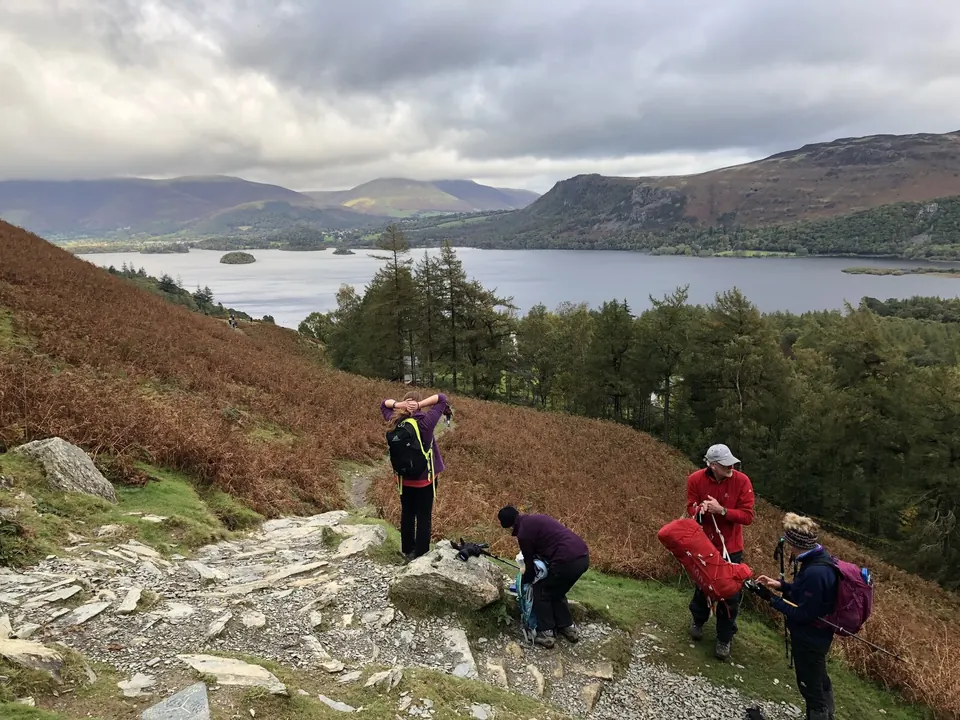
Is Catbells a Good First Fell?
Yes: it's probably the most popular first fell in the Lake District. Wainwright called it "a family fell where grandmothers and infants can climb the heights together". It's short enough to fit in a morning, you can see where you're going all the way, and the view of Derwentwater opens up early in the climb.
Two honest cautions. It's a real fell, not a path in a park: you need shoes that grip, a waterproof and something warm. And don't judge it by its height: pick a dry day with light wind for a first visit. Check the summit forecast.
How Fit Do You Need to Be?
If you can walk steadily uphill for an hour with short rests, or climb the stairs of a tall building without stopping more than a few times, you can get up Catbells. Take it in stages: the top of each rise is a natural place to stop.
Trainers or Walking Boots?
- Dry summer day: trainers or trail shoes with a good tread are fine. Smooth-soled fashion trainers aren't: the rock steps need grip.
- After rain, or any day outside summer: walking boots or shoes. The stone path down from Hause Gate is slippery when wet.
- In frost, ice or snow: boots, and microspikes for the path. The rock steps in ice are for people with winter experience.