
Why Is It Called Catbells?
Nobody knows for certain. The explanation given most often, and repeated by Alfred Wainwright, is that the name is a worn-down form of "Cat Bields", meaning the shelter or den of the wild cat. Wild cats did once live on the Lakeland fells, so it's believable, but there's no document that proves it. The Ordnance Survey spells it as two words, Cat Bells; walkers, signposts and most guidebooks run them together.
Mrs Tiggy-Winkle
Beatrix Potter knew this side of Derwentwater well. Her family took summer holidays at Lingholm and Fawe Park, the big houses on the shore north of Hawes End, and she sketched the fell, the lake and the Newlands valley on those visits.
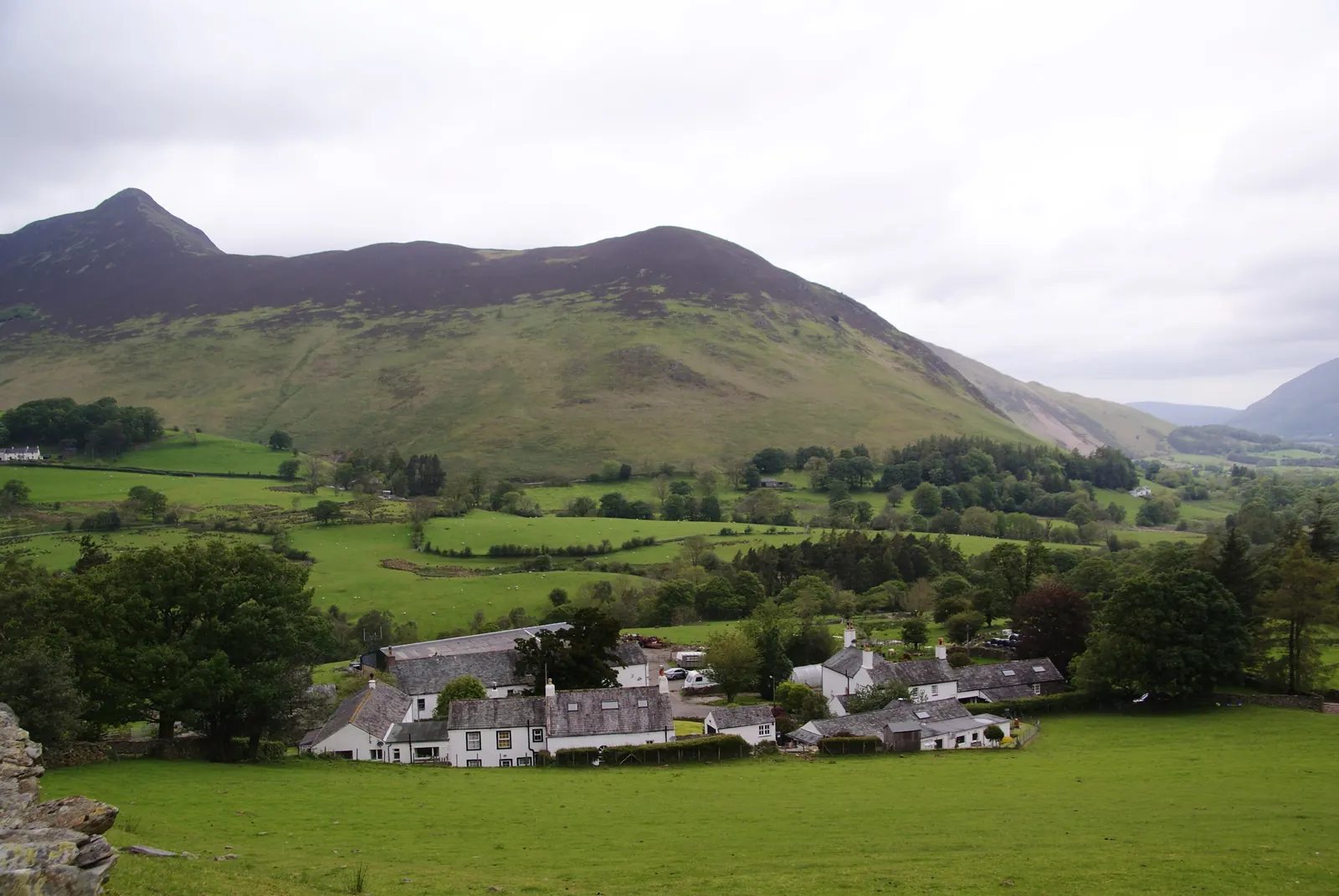
The Tale of Mrs. Tiggy-Winkle, published in 1905, is set here. A little girl called Lucie, who lives at a farm called Little-town, climbs the hill behind it looking for her lost handkerchiefs and finds a door in the fellside, behind which a hedgehog washerwoman is doing the laundry. Little Town is a real hamlet at the western foot of Catbells, and Lucie was a real child: Lucie Carr, a daughter of the vicar of Newlands. The pictures in the book show the Newlands valley and the path up towards the ridge much as they are now.
You can walk through Little Town on the Newlands round.
Hugh Walpole at Brackenburn
On the lake side of the fell, below the terrace path, is Brackenburn, the home of the novelist Sir Hugh Walpole from 1924 until his death in 1941. He called it "a little paradise on Cat Bells" and wrote the Herries Chronicle here, a family saga set in Borrowdale and around Keswick that was a huge seller in the 1930s. The house is private, but beside the path above it there is a memorial seat with a plaque: "To the memory of Sir Hugh Walpole, CBE, of Brackenburn. This seat is erected by his friend Harold Cheevers, September 1941." The classic walk passes close to it on the way back.
The Leonard Memorial
On the way up the north ridge, by the first rocky step, a metal plaque fixed to the rock remembers Thomas Arthur Leonard (1864 to 1948). Leonard was a Congregational minister in Colne, Lancashire, who started taking mill workers on walking holidays in the 1890s, and went on to found the Co-operative Holidays Association and the Holiday Fellowship. The plaque calls him the "'Father' of the open-air movement in this country". Thousands of people pass it every week doing exactly what he had in mind.
The Mines
Catbells is riddled with old lead workings. Yewthwaite Mine, on the Newlands side above Little Town, has left large spoil heaps; Brandlehow and Old Brandley mines worked a vein on the Derwentwater side. All of them had closed by the 1890s. Mining in the Newlands valley goes back much further: German miners were brought to Keswick in Elizabeth I's reign to work copper at Goldscope, on the other side of the valley. See safety for why you should keep out of the old workings.
Brandelhow and the National Trust
The woods along the lakeshore at the foot of Catbells, Brandelhow Park, were the first land the National Trust bought in the Lake District, in the early 1900s, with money raised by public appeal so that people would always be able to walk by the lake. The classic walk comes back through them.
Wainwright on Catbells
Alfred Wainwright gave Catbells a chapter in his guide to the North Western Fells and wrote the line everyone quotes: "It is one of the great favourites, a family fell where grandmothers and infants can climb the heights together, a place beloved."